Platform
One platform. One loop.Everything on the record.
Six surfaces — Radar, Spaces, Agents, Boards, Documents, Workflows — built around a single idea: information becomes knowledge only after your review, and AI works only from what you've approved.
Overview
Most AI tools bolt a chatbot onto data nobody governs. Blinkin does the opposite: it puts a review gate between the open web and your knowledge, and lets AI act only on the far side of that gate. Six surfaces share one loop — watch, curate, ask, build, automate — so what a team sees, decides, and ships stays on the same record.
Feature
One loop, six surfaces
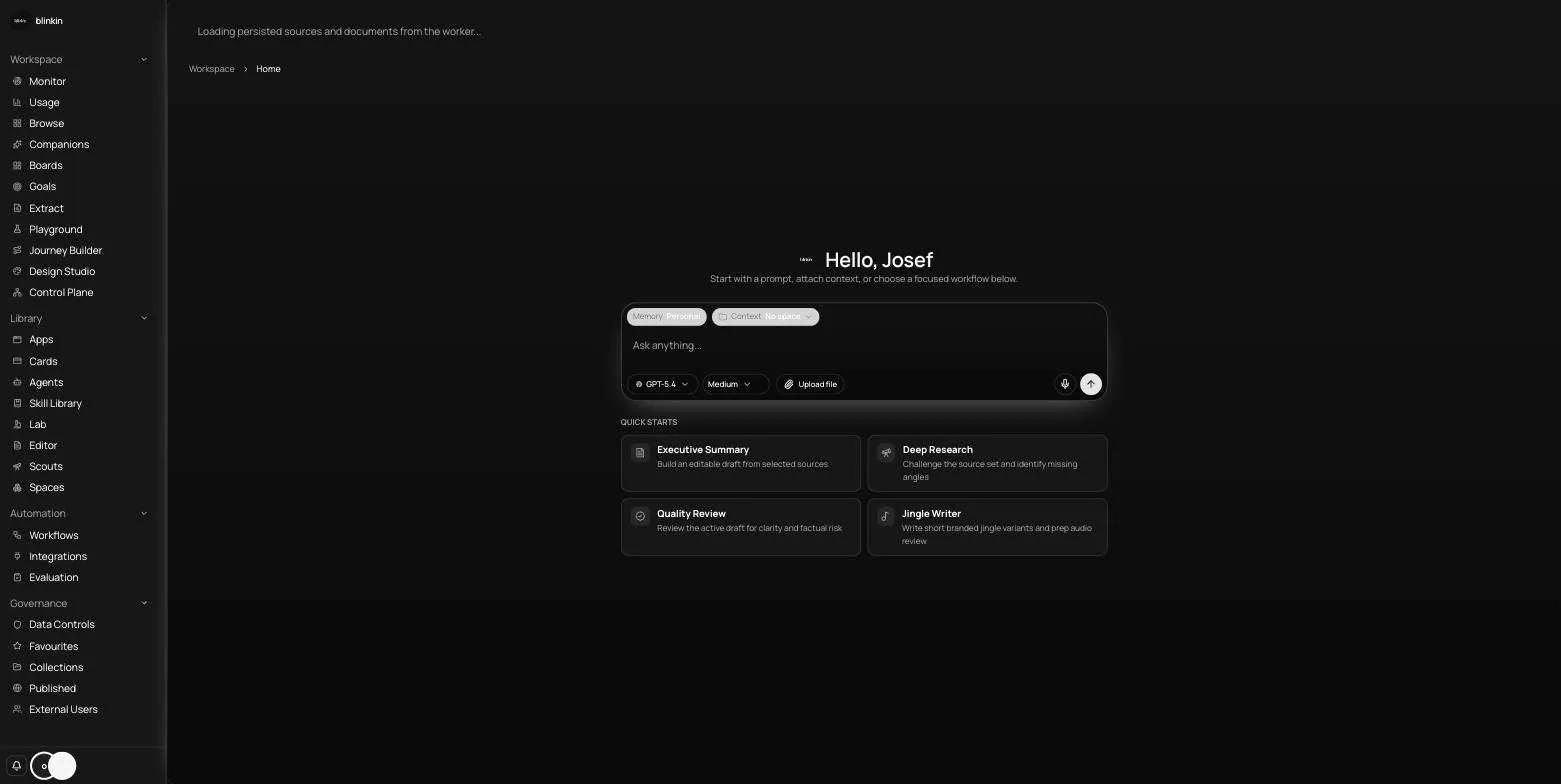
Radar watches, Spaces curate, Agents and Documents ask and draft, Boards and Workflows build and automate. They aren't six products stitched together — they read and write the same governed knowledge, so an approved fact is instantly usable everywhere.
Feature
A review gate, not a data lake
Nothing an integration ingests counts as knowledge until a person promotes it. The Inbox is the one valve every candidate passes through — signals, emails, uploads, form submissions, AI drafts, document revisions — before it can be cited as truth.
Feature
Citations by construction
Because knowledge is reviewed and sourced, every answer, briefing, and agent output can link back to the approved document behind it. Grounding isn't a bolt-on; it's what the loop produces.

Information becomes knowledge only after your review, and AI works only from what you've approved.
Feature
Governed AI, any model
One AI gateway sits between your work and the model vendors. Claude, GPT, Gemini and more run behind provider-agnostic routing with retry, fallback and policy — so you switch models without rebuilding a single agent.
Feature
Per-organization isolation
Each organization runs on its own physically isolated data store, behind Auth0 org SSO, hosted in the EU. Your material is not co-mingled with another tenant's.
Feature
Everything leaves a trace
Runs, approvals, edits and publications carry an audit trail. When someone asks "who changed this, and on what evidence?", the answer is in the record, not in someone's memory.
Feature
From prototype to operations
Most teams have AI prototypes; few have AI operations. Blinkin is the difference — review, approval, measurement and audit wrapped around the work, so what impressed in a demo survives contact with Monday.
Feature
Quality, measured
Output quality is scored — fact-faithfulness, tone, client specificity — and reviewed like everything else. Every failure class becomes a better rule, so improvement is a loop, not a hope.
Feature
Open by design
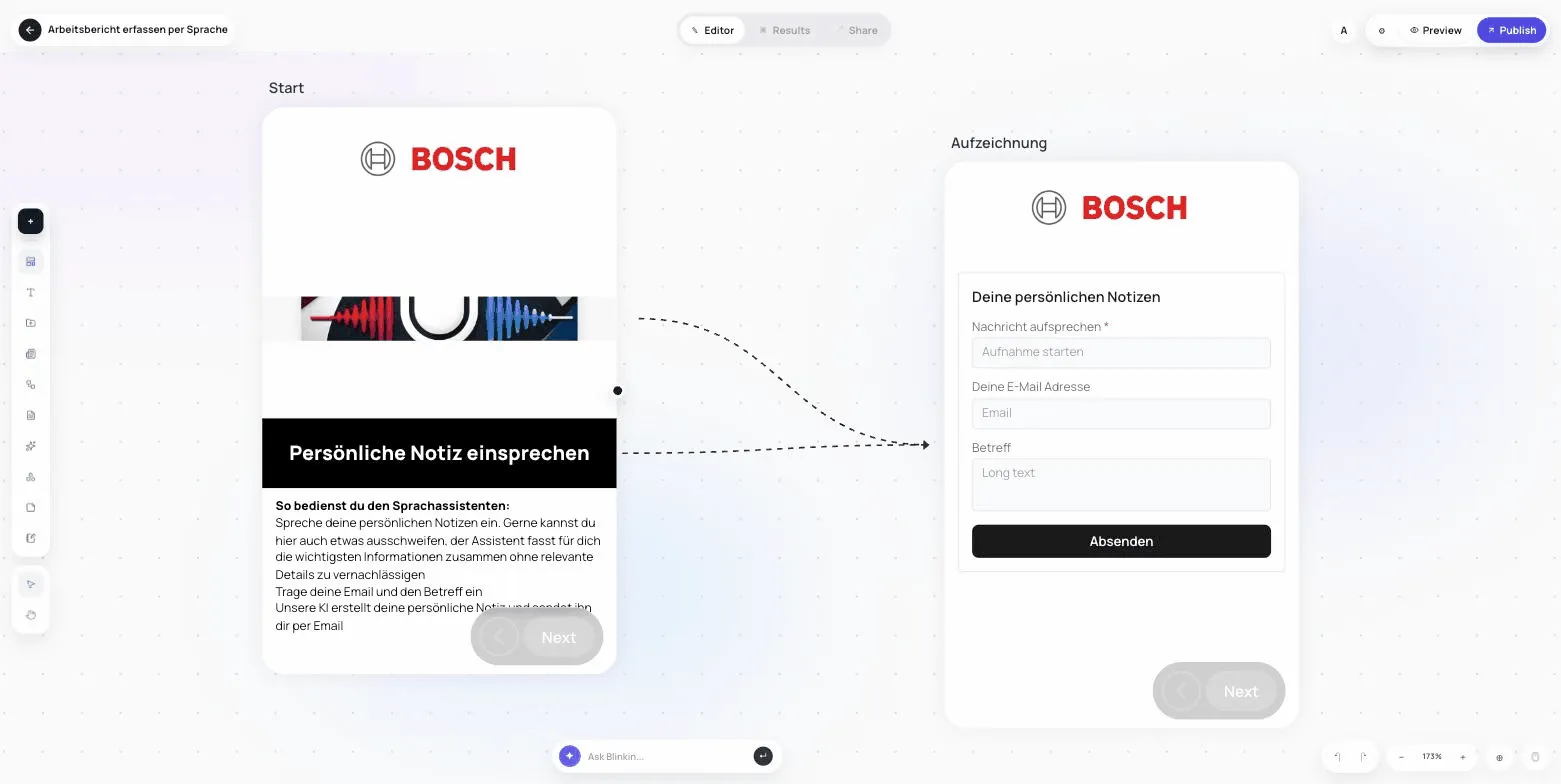
Blinkin plugs into the stack you already run: agents chat in Microsoft Teams and answer Blinkwoot service inboxes, any published agent embeds on any website, and an MCP gateway plus CLI let your own tools publish into a Space — governed like everything else.
Feature
A marketplace, on the horizon
Coming soonAgents and apps from Blinkin, from partners, and from your own organization — distributed under one subscription and entitlement model, so what a team may use is as governed as what it does.
Feature
Built for how teams already work
Early accessNotification inbox, favourites and collections, embeddable widgets, and usage quotas with billing come standard. An external-users directory for sharing beyond your org is in early access.
Value loop
The five verbs
Surfaces
Six doors
How it works
How it works
Watch
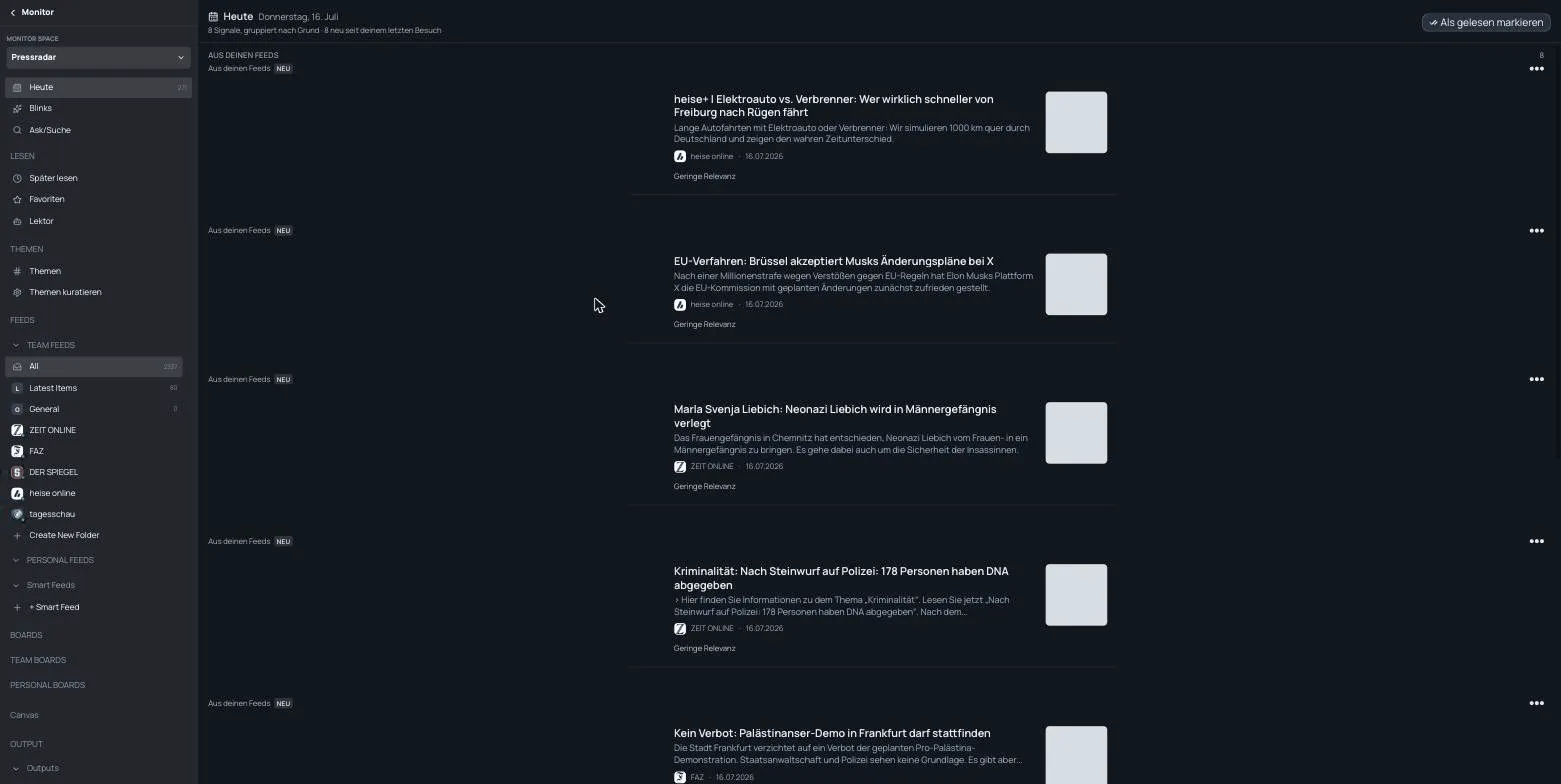
Radar and integrations pull signals from the web, inboxes and files into the Inbox.
Curate
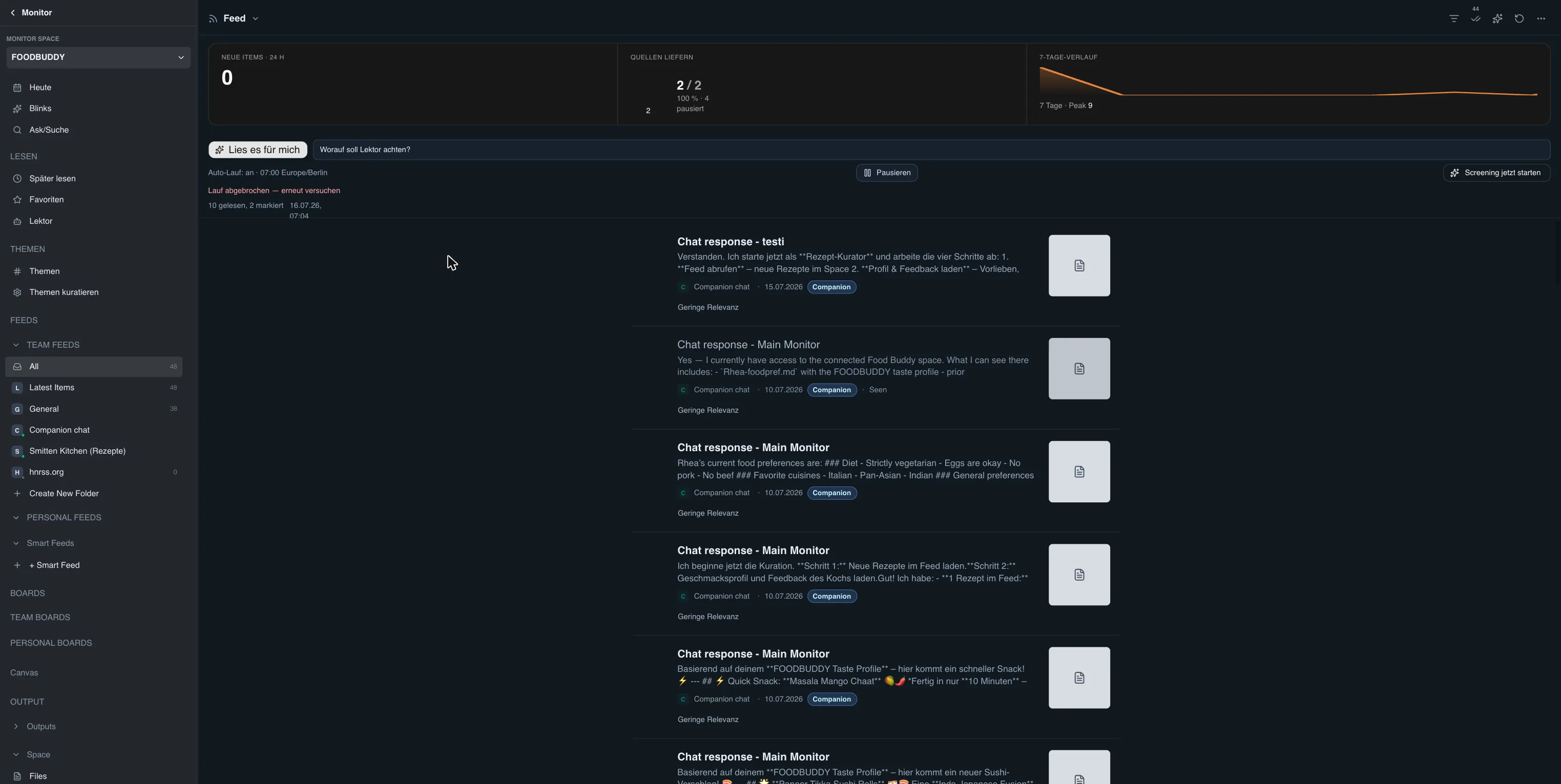
Your team reviews candidates and promotes what's true into Ground Truth Knowledge.
Ask & build
Agents, chat, documents, boards and workflows draw on approved knowledge, with citations.
Back to review
Everything AI produces routes back through the gate before it becomes knowledge again.
In practice
In practice
A knowledge lead consolidates a scattered topic — RSS sources, PDFs, past decisions — into one Space, reviews what belongs, and hands the team a single governed home instead of six shared drives.
An operations manager turns a recurring quarterly process into a workflow with approval gates, so the same steps run the same way whether a person or an agent starts them.
A communications director asks a cited question across everything the team tracks and gets an answer they can defend in the next meeting, each claim linked to its source.
Questions
FAQ
Do I have to adopt all six surfaces at once?
No. Teams usually start with Radar or Spaces and grow into the rest. Because they share one loop, adding a surface later doesn't mean re-importing your knowledge.
How is this different from a chatbot on our documents?
The difference is the review gate. A chatbot answers over whatever it's fed; Blinkin answers only over knowledge a human has approved, and every answer carries citations back to it.
Which AI model does it use?
Whichever you choose. The AI gateway is model-agnostic across Claude, GPT, Gemini and more, with routing and fallback handled for you — no lock-in to one vendor.
Is our data used to train models?
No. See /trust for the full data-handling answer; the short version is that your material stays in your isolated org store and is not used for model training.
What's actually live versus early access?
Every early-access feature carries an "Early access" label on its page. If it isn't labeled, it's shipping today.
Governance
Governed by design
EU hosting
Per-organization data isolation
Full audit trail
Review-gated knowledge
Works with any AI model
Next step